Asking in behalf of the customer..
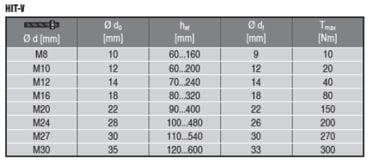
there are specific required torque for each anchor type/diameter. for HAS M30 + HIT RE500v3, it is 300N-m.
Question 1: is there a specific range for this, say what if the applied is only 290N-m, or 310N-m?
Question 2: do we have calculation, how did we come up with the required torque? if torque is applied, there will be a specific axial force on the anchor, could we have a calculation of that.
Answer to question 1: The required torque should be followed based on the values given in the approval of the anchor, ESR 3814 specifically for RE500v3 + HAS Rod under the MPII. There’s no tolerance for the torque requirements given. For adhesive anchors, torquing is required so that the fixture will be secured against the concrete surface. Under torquing may result to a loose fixture and poor contact between baseplate and concrete. Over torquing on the other hand, may result to steel breakage or losing the adhesion especially if the mortar is not yet fully cured.
Answer to question 2: As part of the research and development, torque requirement per anchor is established by extensive laboratory tests like torque vs capacity test which we determine the optimal torque that will ensure enough pre-load for maximum performance and avoids over stressing at the same time.
Answer to question 3: When torqued, there is an axial load or pre-load created. But ACI 318 does not explicitly require to add it to the external service loads in the design but is only a part of the installation process. Also, the pre-tension forces and loss of pre-tension is accounted for as an installation torque under the assessment/evaluation of anchors. So there's no need to calculate the axial force created.
Thank you for reaching out via email.
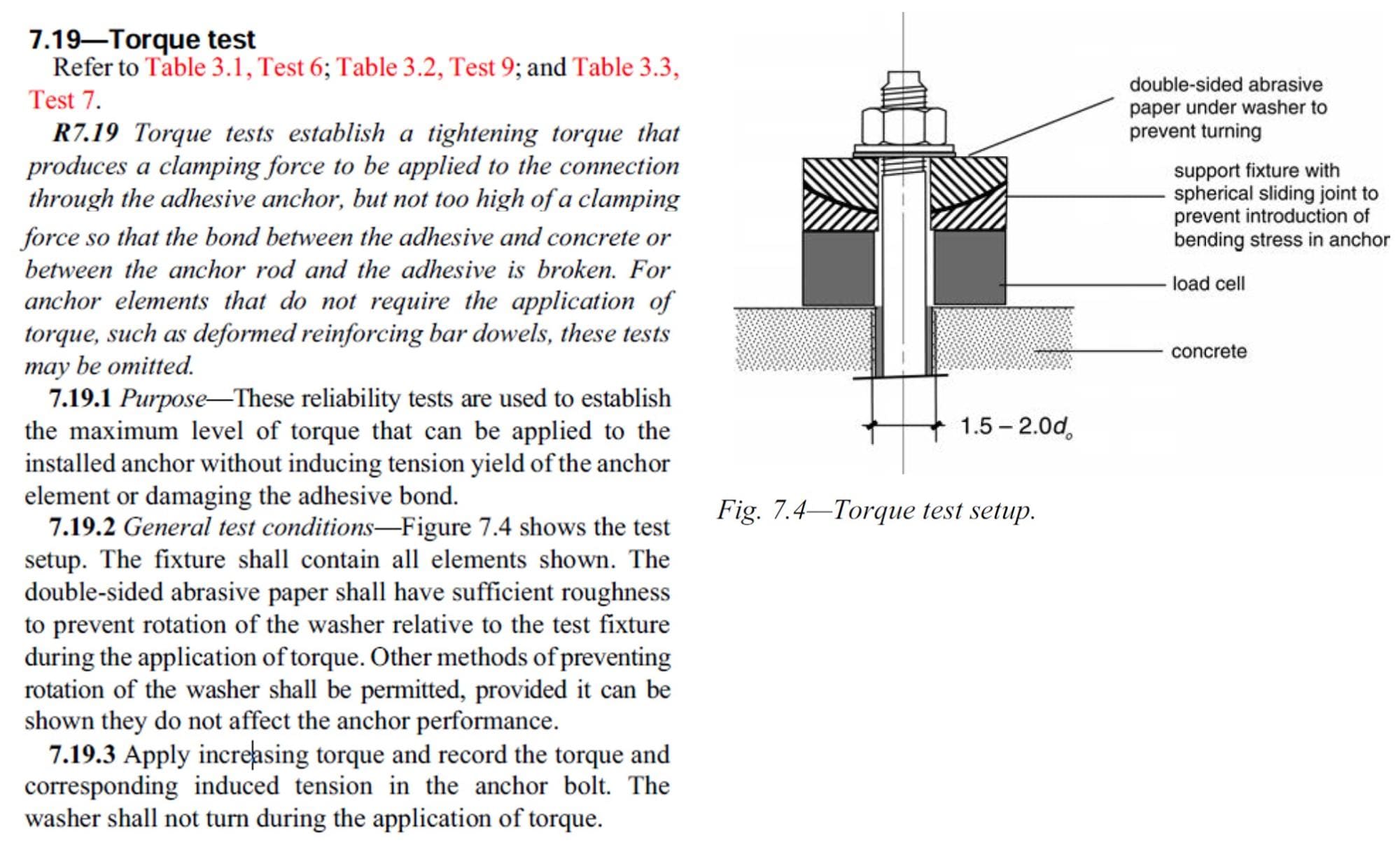
To further expound the answer for question 2, we based the torque test procedure in Acceptance Criteria ACI 355.4 section 7.19 (see attached screenshot) to derive and get the results for the maximum torque. Thus, the test results is directly reflected in the ESR. Refer to the attached ESR-3814 figure 8A page 37. No additional reports were generate
For question 3, generally in Engineering practice they use P = T/kd.
- Where T = Torque (in-lb)
- K = Constant to account for friction (0.15 - 0.2 for these units)
- D = Bolt diameter (inches)
- P = Clamping Force (lb) / Axial force
But again, we do not use this equation in anchor design because the axial force created by torquing is already been taken in to account in the capacity values given in the ESR.